Porcelain. When it first appeared in Europe in the Middle Ages, it caused a sensation. So rare, precious and mysterious, it was a gift to be treasured by kings. And it acquired divine status when Renaissance artists featured porcelain vessels cherished by gods in mythological feast scenes. Indeed, for centuries, in Europe, it was as desirable and as valuable as gold. No wonder it was called ‘white gold’.
In 1270s, Marco Polo became the first European to see and describe the manufacture of porcelain in China. He is credited with giving it the name porcellan because it reminded him of the hard, shiny quality possessed by cowrie shells, known in Italian as porcelleta (meaning little pig).
The term porcelain has no equivalence in the Chinese language. That is because the process of making it was not discovered overnight but rather evolved over centuries out of what we now refer to as proto porcelain. And that can be traced back to the Han Dynasty.
Nevertheless, there must have been a watershed period during which the transition from proto to porcelain took place. Most scholars agree that it occurred during the late Tang dynasty. And although our Tang shipwreck cargo (circa 830 AD) contains nothing but stoneware, the whiteware from the Xing kilns is so close to the real thing that I have heard one expert describe it as ‘porcelaneous stoneware’. Within a century later the Xing and Ding kilns were supplying the imperial household with what would be recognised today as true porcelain.
So how do we define true porcelain? Its perfection is achieved by combining Kaolin (white clay) with a certain amount of petuntse (feldspar) and firing at a very high temperature (1400 degrees C). The result is a ceramic whose elements are vitrified and whose body is so hard that it is resonant and, when thinly potted, it can be translucent.
The Middle Eastern Craving for Porcelain
For several hundred years, the main export market for porcelain, in particular blue and white porcelain, was the Middle East. And the first examples to reach Europe were a spillover from this market.
Perhaps it is therefore not surprising that it was in the Middle East that the first attempts to replicate porcelain were made. It was discovered that by adding ground up quartz or silica to the clay and firing at a high temperature, a superior form of stoneware could be achieved. This became known as Stonepaste or Fritware.
However, to emulate the brilliant white effect of Chinese porcelain the dirty coloured clay had to be covered with a white tin glaze. And it was upon this white surface that the cobalt blue could be painted to resemble Chinese blue and white porcelain.
Imagine if you were able to insert your hand into the display cabinet and flick the edge of the Chinese dish with your fingernail it would emit a resonant “ding” sound. Whereas if you were to do the same with the Turkish emulation you would hear a dull “dung”.
As early as the 13th century the Middle Eastern ceramic techniques of imitating Chinese porcelain had reached Spain and Portugal via North Africa, thanks to the Moors. The process involving first coating earthenware with a white tin glaze was exported from Spain to Italy via the port of Majorca. So, it became known in Italy as Majolica. When the French imported it via the Italian city of Faenza they called it Faience. And when the process reached the Netherlands the English referred to it as Delft.
Europe gains direct access to porcelain
It was not until 1513 that the Portuguese reached China directly by sea. And this was the beginning of the importation of blue and white porcelain designed to appeal to European tastes. An early example at ACM shows a plate with the coat of arms of Manuel I, King of Portugal who died in 1521.
Although the secret of how to produce porcelain seeped into Korea, and by the 16th century had reached Japan, Europe remained oblivious. Attempts to extract the secret through espionage only led to false trails. Like the rumour that porcelain was made from ground up seashells which were then buried underground for 70 years.
Attempts to discover the secret in the 16th century led the Italians to experiment with adding lime and ground-up glassy substances to impure Kaolin clay to produce something close to porcelain, but not as hard. This was called soft-paste porcelain. The French and English came up with similar variants experimenting with other additives including soapstone and bone ash. But the discovery of how to make the real thing, hard-paste porcelain, comparable to the Chinese original, was a prize won by the Germans.
The great discovery in Saxony
Augustus the Strong, Elector of Saxony was a fanatical collector of porcelain. In his service and under virtual imprisonment was an alchemist called Bottger, who boasted that he could convert base metals into gold. In this endeavour he failed. But when he collaborated with ceramists the team managed to produce a red clay stoneware that rivalled the Chinese production of Yixing, which was famous for its non-porous unglazed teapots. Further experimentation with two sources of impure Kaolin clay, to which small amounts of alabaster and silica were added, produced genuine hard-paste porcelain. With the enthusiastic support of the king, a porcelain factory was established in 1710 in an old fortress at Meissen, close to Dresden.
By 1715 the quality had improved and early Meissen figures succeeded in faithfully copying Chinese blanc de chine originals. Initially the factory continued to be influenced by Chinese designs. However, with the attraction of local modelling and painting talent the factory became independently creative, reflecting the Baroque fashion of the age. And for half a century Meissen dominated the market for porcelain, setting the style and standard for figurines and tableware throughout Europe.
Despite attempts at secrecy the formula for making hard-paste porcelain did reach Vienna. However, the rest of Europe continued to try to emulate Meissen’s production using soft-paste for most of the 18th century. The V&A museum in London provides an
interesting insight into the difference between the two types of porcelain. A hard-paste Meissen figure of a shepherd is placed next to a soft-paste copy made by the Bow factory of London. As you can see, soft paste could not achieve quite the same fineness and whiteness as the Meissen original.
By the 1750s even the Chinese were copying Meissen. An example of this is supplied by the Walker Museum in Minneapolis which displays a Meissen dancing group made in 1735-37. Alongside is a Chinese copy found in the cargo of the Dutch ship Geldermalsen which sank near Singapore in 1752. After 250 years under the sea the Chinese version has lost its overglaze enamel colouring but there can be no doubt about its attempt to copy Meissen.
A shocking revelation at ACM
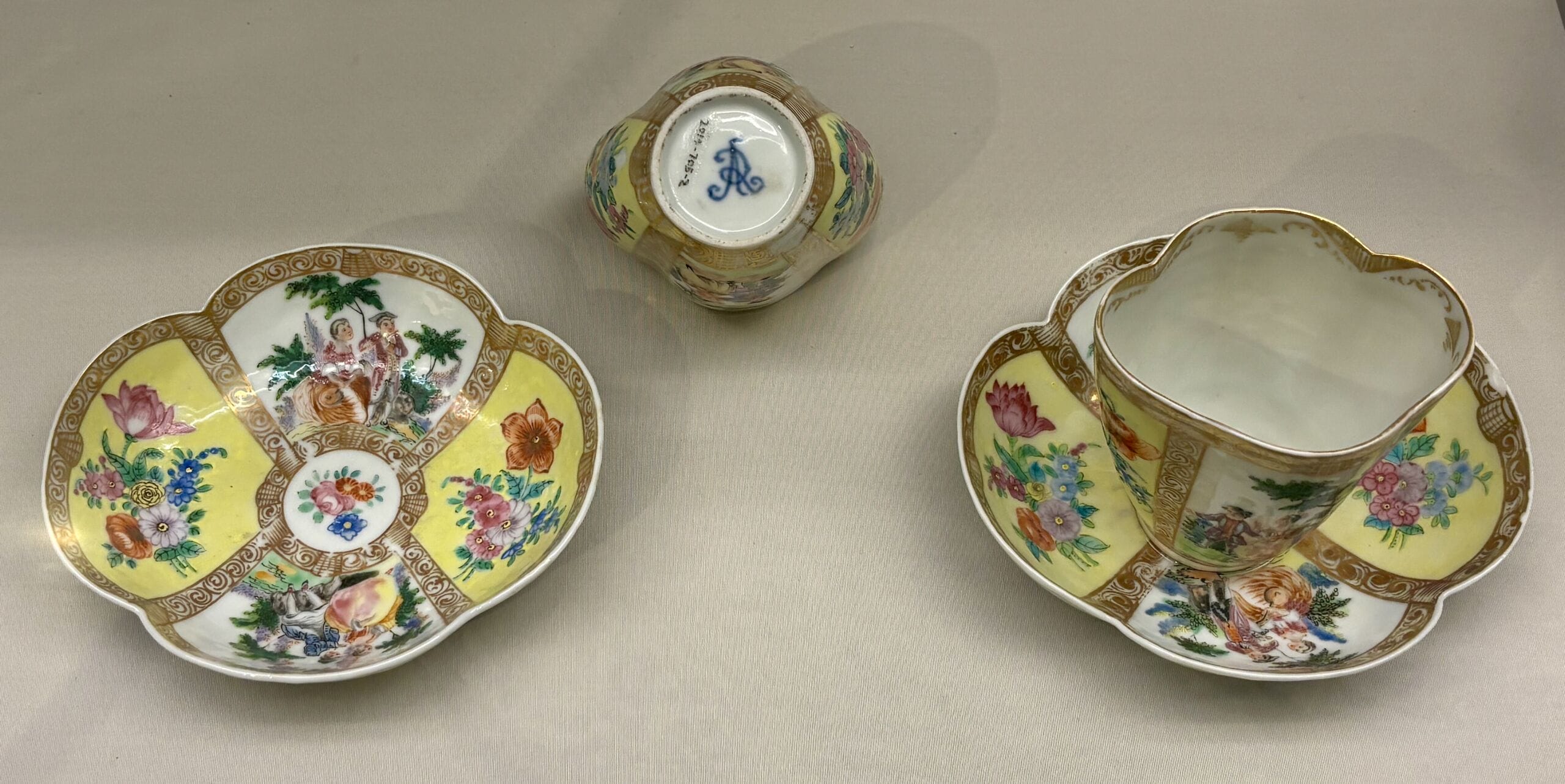
Imitation may be the sincerest form of flattery, but for China it represents an historic turning point. After leading the world in ceramic innovation and creativity for a thousand years, by the end of the 18th century the artistic and technological tide had turned in favour of Europe. Evidence of this is provided by a shocking exhibit at ACM. These teacups and saucers are not just made in the style of Meissen. Worse still, they represent an attempt at forgery by applying on their bases, in underglaze blue, the monogram of Augustus Rex: AR.
This early Meissen hallmark was replaced later by the more familiar crossed swords mark. Genuine pieces bearing the monogram are very rare and desirable because the mark was reserved for objects supplied to the court of Augustus II who founded the Meissen factory. And when he died in 1733 the mark continued to be added to pieces produced for the court of his son Augustus III.
Such pieces could be compared in significance to what the Chinese referred to as ‘Imperial Wares’. They are consequently so rare and desirable that virtually all examples are only to be found in museums or Royal collections. And if you see a piece with this mark on the open market it is likely to be a fake, produced by one of various factories in 19th century Germany, Italy or France. Or maybe even 18th century China. Either way, it would have little value, like Fool’s Gold.